
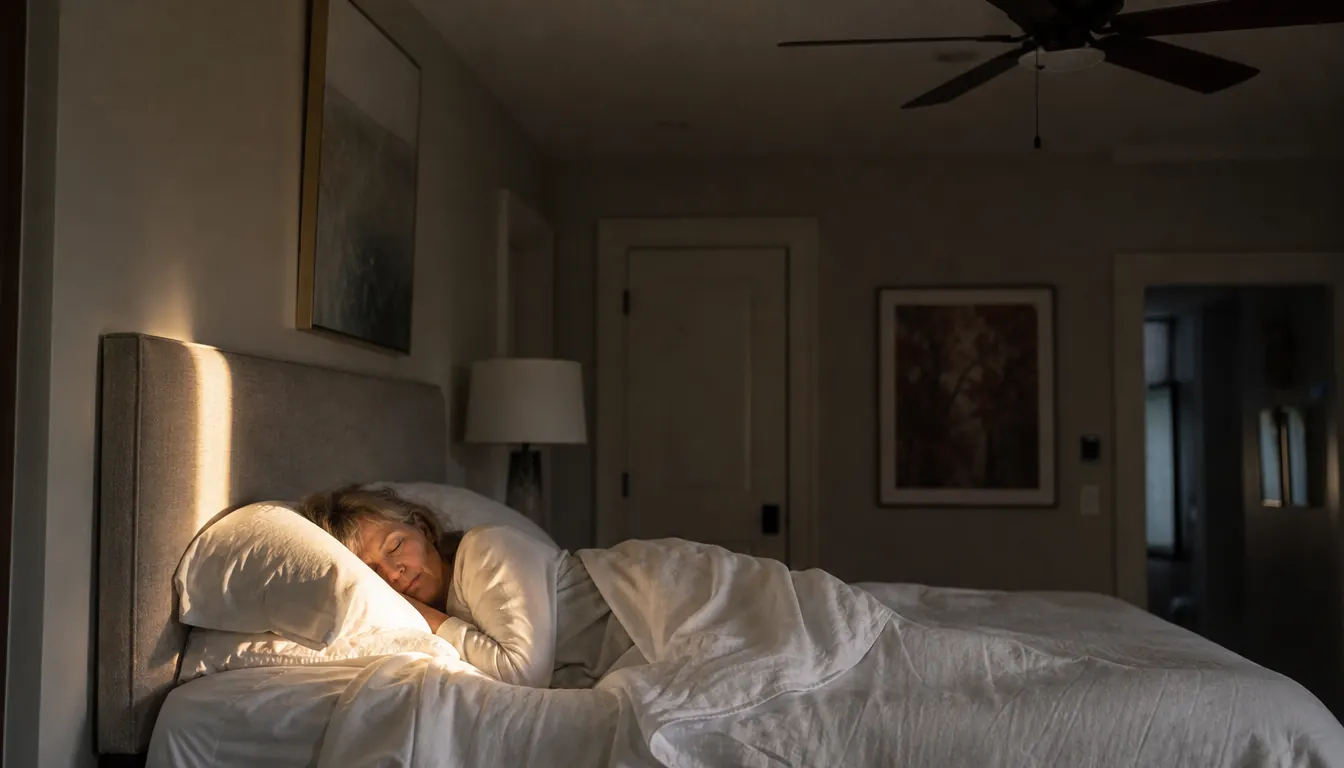
The sun clears the fence behind our neighbor's yard at about 6:45 every morning and lands on my side of the bed. I know the time because for two years I did not need an alarm clock. It hit the top of the pillow first, then my cheek, and whatever sleep I had left was finished. Paul would still be asleep on his side with his back to the window while I lay there at 6:50 with an hour of sleep still owed to me.
I tried the obvious things first. I folded a T-shirt and laid it across my eyes; it slid off by two in the morning and I would find it on the floor beside the bed. I bought a flat drugstore mask and it pressed my eyelashes back against my eyelids, which is its own small misery. I tried going to bed earlier, which only moved my 3 AM wake-up to 2:30. What worked was a sequence, and the first item in it was the MZOO sleep mask, a contoured memory foam mask I have now worn almost every night for about fourteen months. Here is the order I would do it in if I were starting over.
The First Fix Was the One That Covered My Eyes
The MZOO mask seals around each eye instead of pressing on your lashes, which is the difference between waking at 6:45 and sleeping through it. It is the piece I would start with and the piece I would replace last.
Amazon Check Today's Price on Amazon →Step 1: Find Out Exactly When and Where the Light Lands
Before you buy anything, spend a few mornings noticing. Noticing is free and it tells you whether you need a mask at all. Sit up when you wake and look at where the light is coming from: the gap at the top of the curtain rod, the edges of the blinds, a sliver where two panels meet. Write down the time, even roughly, on the back of an envelope on the nightstand.
I did this for five mornings in a row in early April. My log read 6:43, 6:46, 6:44, 6:45, 6:44. The light was coming from the top left corner of the window, where the rod sits a little proud of the frame, and it fell in a strip about a foot wide across my pillow. Not the whole room. One strip, roughly the width of my head, landing on the exact spot where I sleep. I had been assuming for months that I needed to darken the whole bedroom and it turned out the problem was a rectangle of light the size of a sheet of paper.
That detail is the entire reason a mask solved it, and the reason a room-wide fix alone would have left me with a bright line across my face. Before the log I had already priced out blinds in my head and had a conversation with Paul about whether we could hang a second rod. I was about to spend a Saturday on a ladder to fix a strip of light I could have covered with a hand.
A mask covers your eyes. It does nothing about light that lands on your chest or your feet, and it does nothing about the heat that comes through the glass by mid-morning. If the light hits your eyes, the mask is the direct fix and you can stop there. If it hits the wall and warms the room, you have a different problem, and I will get to it.
Step 2: Pick a Mask That Seals Around the Eyes Instead of Pressing on Them
There are two kinds of sleep mask and they work on different principles. A flat cloth mask blocks light by contact, which means it has to press against your face, which means it leaks at the sides of your nose and pushes on your lashes all night. A contoured mask has cups that sit over the eyes and a rim that touches the face around them, so the seal happens at the edges instead of on the eyelid.
The flat one I bought at a drugstore for a few dollars was the first kind. It was fine for about an hour. Then my eyes started to feel gritty, and by morning I had a faint ache behind them that I did not connect to the mask until I stopped wearing it. When I opened my eyes inside it, my lashes dragged against the fabric every time I blinked. If you have ever fallen asleep in a hat that sits too low, it was that feeling, all night.
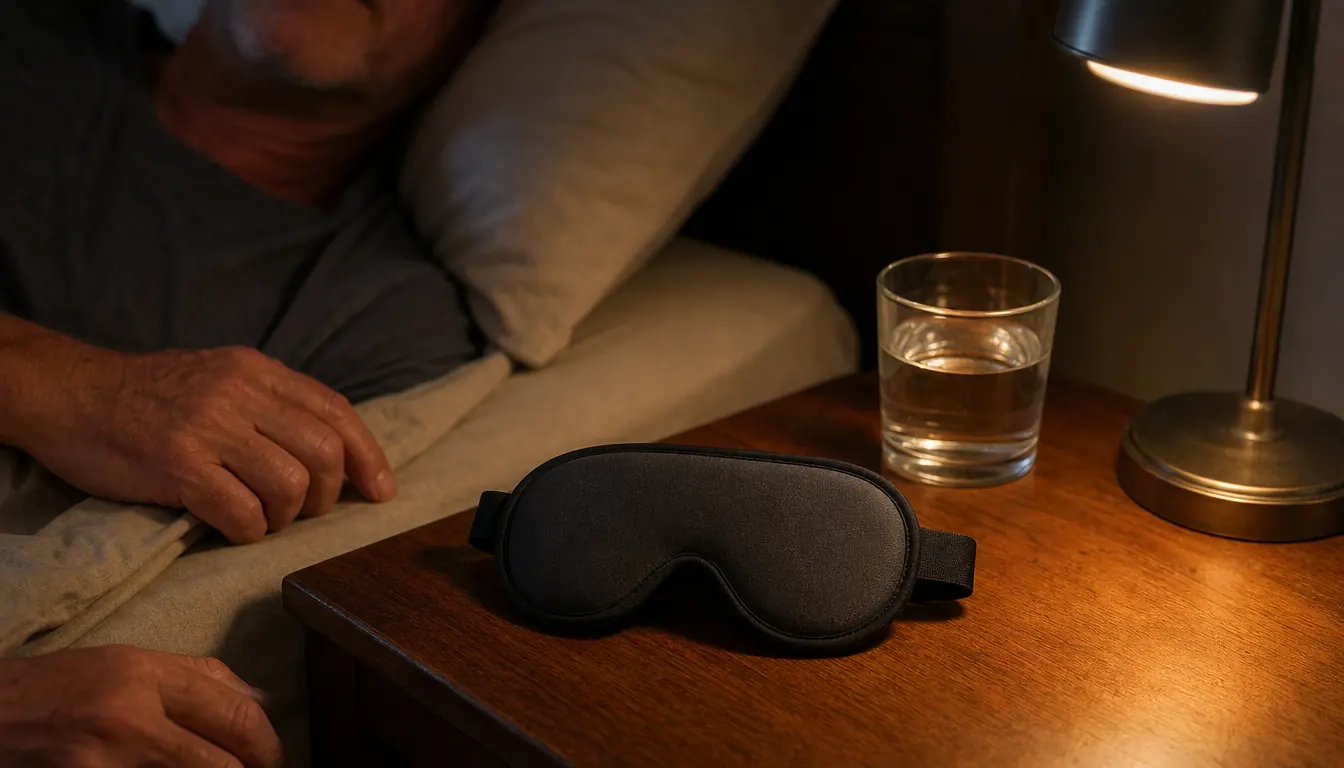
The MZOO mask is the second kind. The eye cups are arc-shaped and deep enough, 13mm, that I can open my eyes, blink, and not touch fabric. The nose piece is 22mm of padding, and that is the part that matters most, because the bridge of the nose is where nearly every mask leaks. The sides are thin and curved at 15 degrees, so when I roll onto my left side the mask settles into the pillow instead of pushing into my temple and waking me at four.
It weighs 5.29 ounces and measures about 10 by 3.9 by 0.78 inches, so it is closer to a small firm pillow than to a scarf. It is low-rebound memory foam, which means it gives slowly and comes back slowly instead of springing. The strap closes with a buckle rather than hook-and-loop, and the adjustment holds where you set it. The outer material is breathable enough that I do not wake with a damp forehead, which was a real problem with the cloth one in a Tampa June.
Step 3: Fit the Strap So the Mask Stays Where You Put It
Fit matters more than people expect. Put the mask on and tighten the strap until the rim touches your face all the way around with no gap, then back it off one notch. Too tight and you will feel it at the temples by 4 AM. Too loose and it lifts off the nose every time you turn over.
I got this wrong at first. I tightened it until it felt secure and wore it that way for four nights, and every one of those nights I woke around four with a dull pressure above my ears. I assumed the mask was not for me. It was one notch too tight. Backing it off took ten seconds and the temple ache never came back. Do the fitting in the evening while you are sitting up, not at bedtime when you are already tired and inclined to yank it snug and be done.
Because the strap buckles, you set it once and forget it. An earlier mask I owned closed with hook-and-loop and I was re-tightening it every second night, which meant the fit was slightly different every night and I was guessing at why some mornings worked. This one has not moved since the first week, and I could not tell you the last time I adjusted it.
Side sleeping is the real test. I sleep on my left, the side facing the window, and Paul reads with a small lamp on his side for about twenty minutes after I turn in. The mask handles the lamp now. That was not the reason I bought it, but it turned out to be worth as much to me as the sunrise, because it means I am not lying there waiting for him to finish a chapter.
Fourteen months in, the strap has not stretched, the foam has not gone flat, and I have not been woken by the 6:45 sun since the second week.
Step 4: Wash It by Hand Once a Week So the Seal Keeps Working
The MZOO mask is hand wash only, and that is not a suggestion. Memory foam goes stiff and lumpy in a machine. Once a week I fill the bathroom sink with cool water, add a drop of mild hand soap, work it through the foam with my fingers, rinse until the water runs clear, squeeze it gently without wringing, and lay it flat on a towel. Two hours later it is dry.
I nearly ruined mine in the first month. It was late, I was tired, and I dropped it in the washing machine with a load of towels on cold. I caught it before the spin cycle and it came out intact, but the foam had taken on water like a sponge and it sat on the counter for a full day before it felt right again. Do not do what I did. The sink takes four minutes.
Skip the washing for a month and you will notice the mask starting to slip. Night cream and skin oils build up on the surface that touches your face, and a slick rim does not seal. I wash mine on Sunday morning, which gives it all day to dry before I need it again, and I keep a note on the bathroom mirror so I do not talk myself out of it. I own one mask, so the timing matters. If I were buying again I might keep a second one for the drying day, but I have not bothered, and the Sunday schedule has held for over a year.
Step 5: Give It Two Weeks, Then Fix the One Thing That Still Wakes You
The first three nights, a mask on your face feels like a thing on your face. You will notice it, you may press on it to check it is still seated, and you may decide it is not for you. Give it two weeks before you decide anything. By the fifth night I stopped noticing it, and by the tenth I was putting it on before I was fully in bed, the way you put on glasses without thinking about it.
One thing that helped in that first week: I set it on the nightstand in the same spot every night, next to the water glass, so putting it on was part of the same motion as turning off the lamp. Small, but it kept me from skipping nights and then deciding the whole thing did not work based on three tries.
After two weeks the sun was handled and I was still waking at 3 AM. That is worth saying plainly, because the mask is not going to fix everything and it never claimed to. My remaining problems were Paul's light snoring and the humidity. Those needed separate answers, and I handled them separately, months apart, one at a time.
That is the method, really. One change at a time, two weeks each, so you can tell what did what. If you buy four things in one weekend and sleep better, you will never know which one earned it, and you will spend years replacing the wrong thing.
What Else Helps
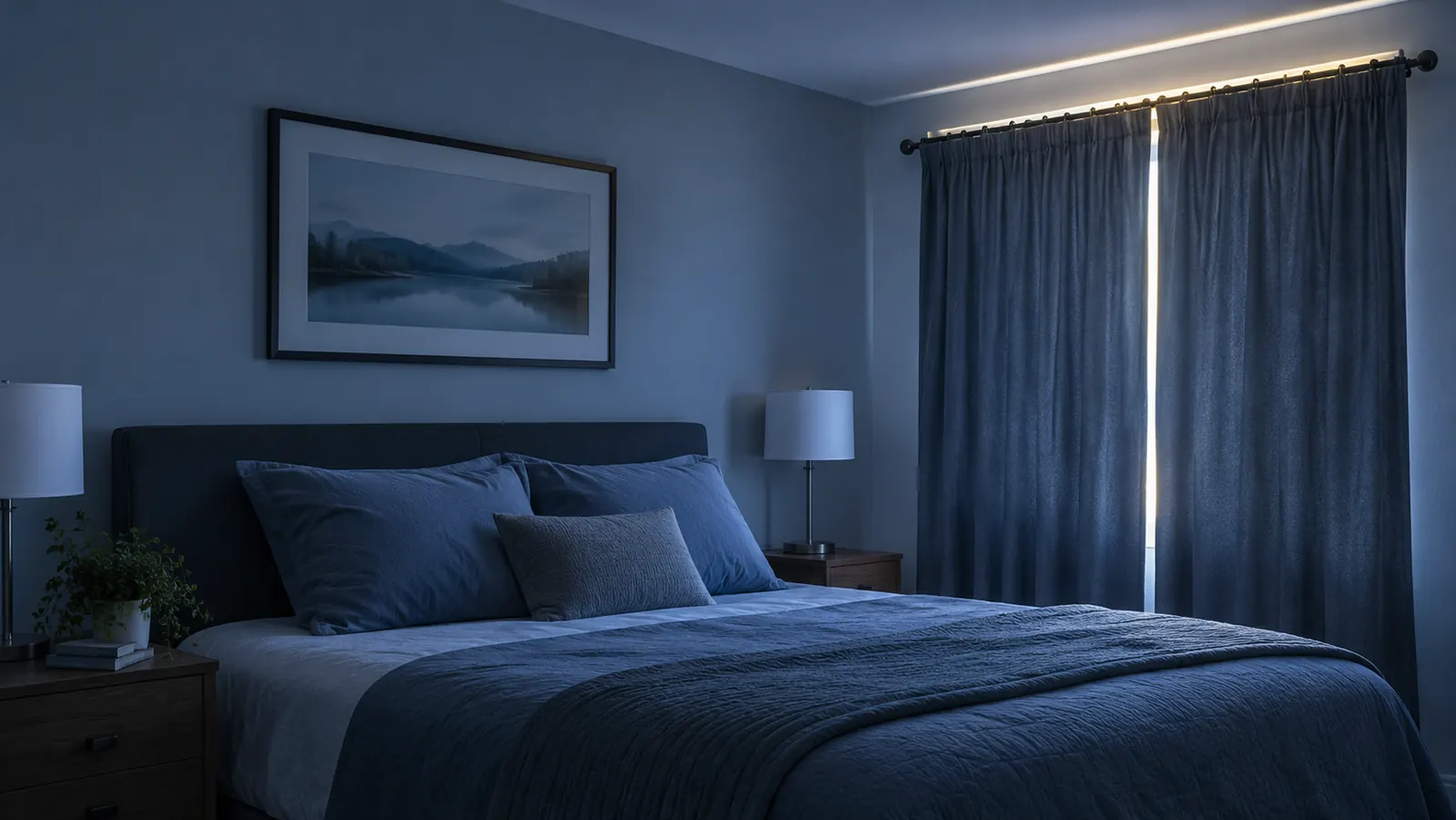
The mask covers your eyes. It does not cover the window, so the same east window that woke me at 6:45 also heats the bedroom from mid-morning, and in a Tampa summer that heat is still in the walls at bedtime. Curtains on that window were the second thing I did, about two months after the mask, and they helped with the temperature as much as with the light. A little light still gets past the edges and over the top of the rod. I do not pretend otherwise.
There is one tension worth naming. If you block the morning light completely, your body has less to go on when it is time to get up, and I did oversleep my walk for a stretch. The light is not the enemy. The light arriving before you are ready is the enemy, and the answer is to control when it reaches you rather than to eliminate it.
The rest is the boring list. Central air at 72, a ceiling fan on low, no caffeine after noon, a walk most mornings around 6:30, and a bedtime I keep within half an hour of the same time every night. None of it is interesting and all of it matters more than any object on the nightstand. The mask is what lets the morning sun stop deciding when my night ends. The habits are what make the night worth having.
Start With the Mask, Then Fix the Room
The MZOO mask is the piece I would buy first, because it handles the one part of this you can solve tonight without a drill or a curtain rod. Set the strap once, wash it by hand on Sundays, give it two weeks.
Amazon Check Today's Price on Amazon →