
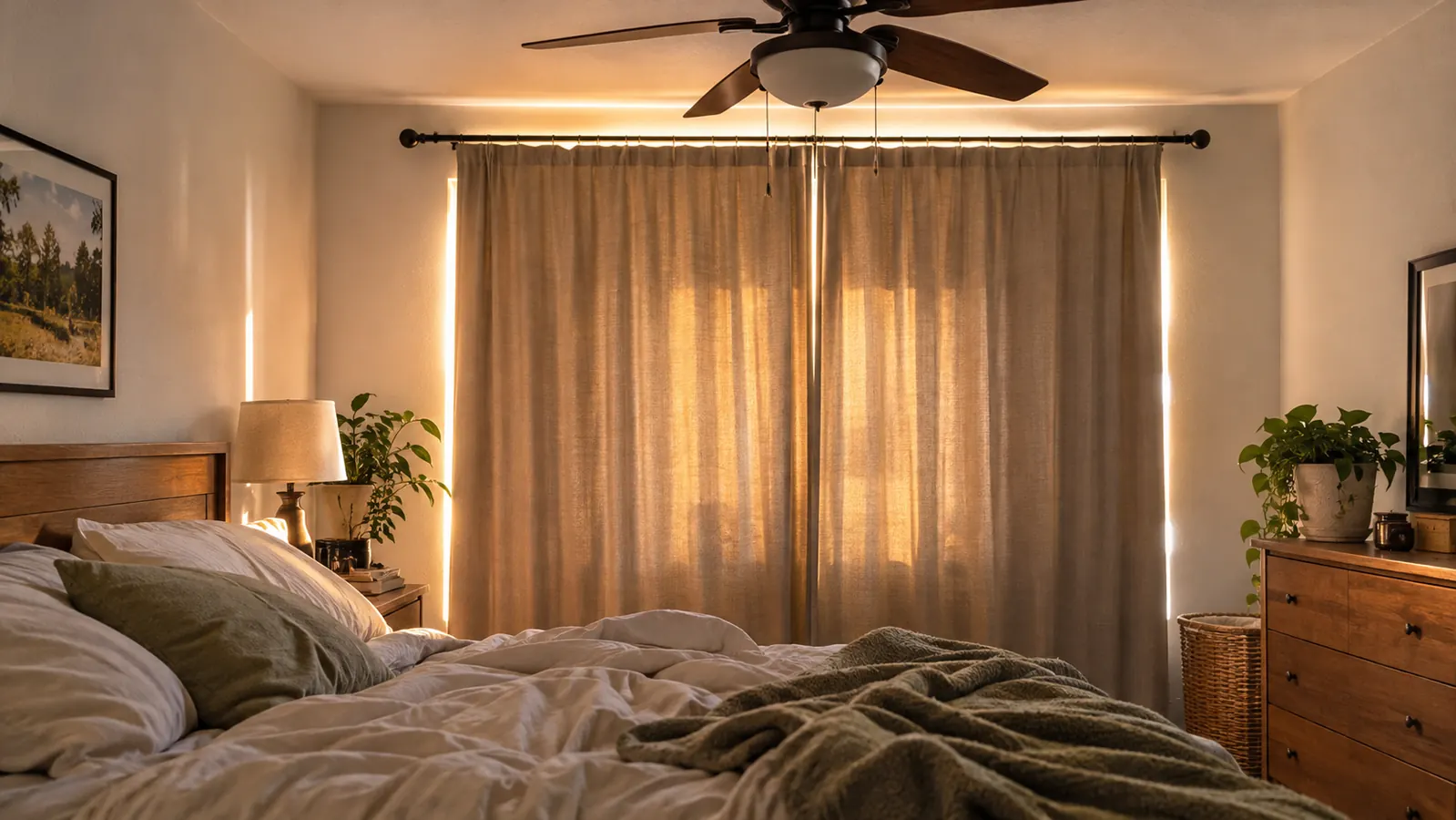
At 6:45 in the morning the sun clears the roofline next door and lands on my side of the bed. I know the time without looking at a clock. I am 54, retired after 24 years in an elementary school health office, and that one east-facing window has been the least favorite part of our bedroom for about three years.
The NICETOWN blackout curtains went up roughly 12 months ago: two panels, 42 inches wide by 63 inches long, grommet top, on a plain rod that Paul and I put up in one afternoon. They did what they were bought to do. They also started a small argument in my head that has not fully resolved, which is whether a bedroom should be dark in the morning or honest about it. Sheer curtains sit on the other side of that argument, and since people keep asking me which one to buy, here is the whole comparison.
The short answer, for sleep: blackout. The listing rates these panels at 85 to 99 percent of light and UV blocked, and in this room that was enough to stop the 6:45 wake-up. Sheer curtains block almost nothing, which is exactly why some people want them. If your problem is light in the morning, blackout is the tool. If your problem is a room that feels like a box, sheer is the tool. Very few bedrooms need only one of them.
| NICETOWN Blackout | Sheer Curtains | |
|---|---|---|
| Light blocking | Listing rates 85 to 99 percent of light and UV blocked. | Blocks almost nothing. That is the point of the fabric. |
| The 6:45 sun on the bed | Keeps it off the bed, with a thin line left at the edges and the rod top. | Lets the room wake up with the sun. |
| Heat from the glass | Triple weave fabric insulates against summer heat and winter chill. | No insulation to speak of. |
| Daytime privacy | You cannot see in from the street at 2 in the afternoon. | You can see in, and out. |
| Feel of the room | Heavier. The window reads as closed even when it is not. | Light and airy. The window still reads as a window. |
| Hardware | Six grommets per panel, 1.6 inch inner ring, fits a standard rod. | Usually a rod pocket or clip rings, depending on the panel. |
| Washing | Machine washable, heavier when wet because of the thickness. | Machine washable, dries fast, creases faster. |
| Straight out of the package | Thread trimmed and wrinkle free per the listing. | Usually needs a steam before it hangs right. |
| Waking without an alarm | The room stays dark past sunrise, so the clock has to do the work. | Daylight does the work, if your schedule matches the sun. |
| Naps and daytime sleep | Dark at 2 in the afternoon, which is the whole point. | Bright at 2 in the afternoon, which is not. |
Where NICETOWN Blackout Curtains Win
The light is the main event. Before the panels went up, the room at 6:45 was bright enough that I could read the label on a pill bottle from bed without my glasses, and I woke at the same minute every morning whether I needed to or not. After, the room at 6:45 is dim enough that my eyes stay closed. That is what 85 to 99 percent means in practice. Not a cave, not total darkness, but enough shade that sunrise stops being an alarm. I noticed the difference on the second morning, not the first, which I think is how these things usually go.
The heat is the part I did not expect to care about. I noticed it first in the late afternoon, around 4:30, when I walked past the bedroom and the room was not the warmest spot in the house anymore. Before the panels, that window took the sun all morning and the glass kept giving it back for hours after. Now the wall of fabric sits between the glass and the rest of the room. The air conditioner runs the same schedule it always did. It just is not fighting a hot pane of glass for the first hour of every cycle.
The second win is the glass itself. A bedroom window in Tampa in July is a radiator with a view, and ours faces the morning sun, which is the worst possible arrangement for a room you want cool at 10 at night. The triple weave fabric insulates against summer heat and winter chill, per the listing, and I believe the summer half. The room does not gain heat as fast in the late afternoon, so the central air is not fighting that window for the first hour it runs. On the hottest nights the air and the ceiling fan still do most of the work. The curtains take one load off.
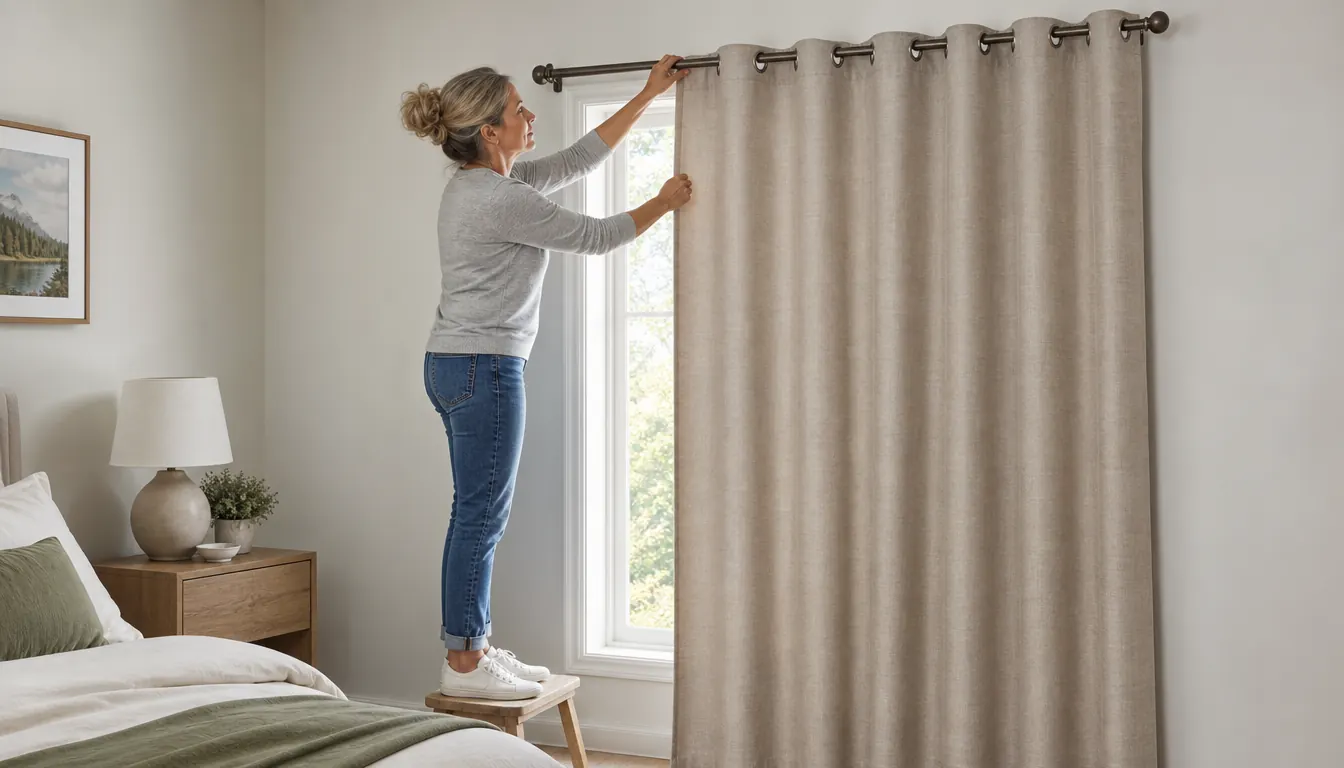
Hanging them was a Saturday job, and it took one afternoon, which is worth saying because I expected a project. Our window is 36 inches across. We put the rod up a few inches above the frame and a few inches past it on each side, drilled four holes, and slid both panels on. Each panel is 42 inches wide, so the pair covers about 84 inches of rod, more than the window needs, which gives you the overlap in the middle and a little wrap at each end. Paul held the level. I held the drill. Nobody swore, which for a curtain rod on a Saturday afternoon is not the usual outcome in this house.
Then there is everything around the fabric. Six grommets per panel and a 1.6 inch inner ring mean the panels slide on a standard rod without fighting, which matters when you are 54 and doing this from a step stool. They arrived thread trimmed and wrinkle free, so there was no steaming session before hanging. The pair is listed at 2.1 pounds and 0.2 inches thick, heavy enough to hang with some weight instead of fluttering every time the air kicks on. Daytime privacy is a real gain too. The room is not visible from the street at 2 in the afternoon, which I did not think I cared about until we had it.
Where Sheer Curtains Win
Sheer curtains win the morning, and I say that as someone who chose the other thing. Paul reads in bed with a small lamp for about 20 minutes after I turn in, and he is the one who misses daylight, not me. A sheer panel lets the room come up with the sun instead of with a sound. If you wake at a reasonable hour, if your schedule follows the sun, and if early light does not bother you, a sheer panel gives you a gentler start than a dark room and a beeping clock. There is nothing wrong with wanting that.
I borrowed the sheers from the living room for a week in March. They were the wrong size for the window, so the fit was never a fair test, but the feel was clear by the second morning. The room came up gray and gradual instead of switching on all at once. By four in the afternoon the same window that had been a wall of fabric was a wall of light, and the bedroom was noticeably warmer than it had been the week before. That was the end of the experiment for me. Paul liked it. Paul also reads under a lamp at 10:15 at night, so his opinion on morning light has a limit.
Sheer also wins the feel of the room. Blackout fabric is heavy by design, and weight on a window reads as a closed window, even on a bright day. A sheer panel keeps the window looking and feeling like an opening. In a small bedroom, or a bedroom that doubles as an office, that matters more than people expect. The room stops feeling like a box with the lid on, and you stop noticing the walls. I hung the sheers for one week and caught myself leaving the bedroom door open just to see the light in the hallway.
The practical version of this is not either/or. A double rod with sheers on the inner track and blackout panels on the outer one gives you both: daylight when you want it, dark when you need it, and a switch you can make in about ten seconds. If I were starting over in this house, that is the setup I would build. Sheer is also the easier thing to try first if you are not yet sure how much morning light actually bothers you.
The panels that made 6:45 stop being an alarm
Two panels, 42 inches wide by 63 inches long, grommet top, rated at 85 to 99 percent of light and UV blocked per the listing. One afternoon with a drill and a rod, and the morning changes.
Amazon Check Today's Price on Amazon →The Edge Light Problem Nobody Mentions
The thing I would tell a friend before she buys: blackout is a rating, not a promise. The listing says 85 to 99 percent, and that range is honest. The fabric covers the window. The last of the light comes around the sides, over the top of the rod, and through the gap where the two panels meet in the middle. In our room that is a thin bright line at 6:45. It is nothing like the flood we had before, but it is there, and pretending otherwise would be silly.
Here is the measurement part, since that is what people actually ask me. Our rod is a plain 48 inch rod with two brackets, and the two panels together carry about 84 inches of fabric, so there is roughly four inches of overlap where they meet in the middle. That overlap is the difference between a dark room and a stripe of sun across the pillow. Before I set the overlap, the gap between the panels at 6:45 was about an inch and a half wide, and it landed directly on my side of the bed. Anyone who tells you a blackout panel fixes edge light on its own has not stood in their own bedroom at sunrise and looked.
If that line would bother you, spend your effort on the hang, not the fabric. A rod a few inches wider than the window, a bracket that holds the panel against the wall, and a small overlap in the middle will do more than a heavier panel on a short rod. We did the overlap and left the rest alone. It is a bedroom, not a darkroom, and I still get up once most nights.
Blackout is a rating, not a promise. The listing says 85 to 99 percent, and the rest of the light comes around the edges.

How I Tested Both in One East-Facing Bedroom
One window, one rod, one king bed, one husband who runs hot and snores lightly. That is the whole lab. The NICETOWN panels have been up about 12 months, washed once, and they still hang straight. For a week in the spring I swapped them for a set of sheer panels I borrowed from the living room, to see what I was missing, and then I put the blackout panels back.
I kept the log on a clipboard by the bed, because a retired school nurse with a clipboard is a hard habit to break. Four lines every morning: the time I woke, whether it was before the clock or after, how many times I was up in the night, and one word for how the bedroom felt when I walked past it in the afternoon. Twelve months of that is more data than I need. The week of sheers is the part I remember, because two of the seven mornings I was awake before 6:15 with no alarm involved.
What I tracked was simple, because I am not a lab: the time I woke, whether I woke before the clock or after it, how many times I was up in the night, and how the room felt at 4 in the afternoon when I walked past it. The blackout week won on sleep, two mornings out of three, mostly because I stopped waking at first light. The sheer week won on mood, and it lost badly on the afternoons when that window took the sun and the room turned into a greenhouse.
The other piece of this is that the room got dark enough to oversleep. That is why a sunrise clock ended up on my nightstand about six months ago, and why I now set it to brighten at 6:00 with a gentle sound at 6:20. If you take the sun out of a room, you have to put something back, or your 6:30 walk quietly stops happening. That is not a knock on the curtains. It is the part nobody tells you about making a bedroom properly dark.
Who Should Buy Which
Buy the NICETOWN blackout panels if light is what wakes you, if you work nights and sleep in the day, if your bedroom window faces east or sits over a streetlight, if you nap, or if your partner reads with a lamp after you are done for the night. Buy them if the room takes afternoon sun and stays warm into the evening. Buy them if you want the window to stop being the first thing you see at dawn. That is most bedrooms, honestly.
Stay with sheer, or layer sheer under blackout, if you wake at a normal hour and like it, if the room is small and needs to feel open, if you rent and do not want to drill, or if you have tried a dark room and found that you oversleep and feel groggy. Sheer is also the right answer for a window you want dressed but not covered. The mistake is buying blackout for a room you actually want light in, then wondering why you sleep through your alarm.
Dark room first. Then whatever puts the morning back on a schedule.
Two panels, 42 inches wide by 63 inches long, grommet top, 85 to 99 percent of light and UV blocked per the listing, and 12 months of my own mornings behind the recommendation. Measure your rod before you order.
Amazon Check Today's Price on Amazon →