

I slept through my own walk for most of last spring. Not every day. Just the mornings when the sky stayed gray and the room stayed dim, which in Tampa in June is most mornings after a storm. I would open my eyes at 7:10, hear the ceiling fan, and do the arithmetic on whether three miles was still possible before the heat came up. Usually it was not.
The problem was one I built on purpose. About a year ago I hung blackout curtains over the one east window because the sun was hitting the bed at 6:45 and I was waking too early. The curtains did their job. Then they kept doing it, and somewhere in there my body stopped expecting morning at all. That is why I bought the JALL sunrise alarm clock about six months ago. Not because I wanted a gadget. Because I had made my bedroom dark enough that nothing was telling me it was time to get up. JALL makes a full-screen wake-up light, and it has been on my nightstand ever since, next to the white noise machine.
If your bedroom is now too dark in the morning, start here
The JALL sunrise alarm clock is the newest thing I added to my sleep routine and the one that actually gets me out of bed. Light first, sound second. That order is the whole idea.
Amazon Check Today's Price on Amazon →It starts waking you before the sound does
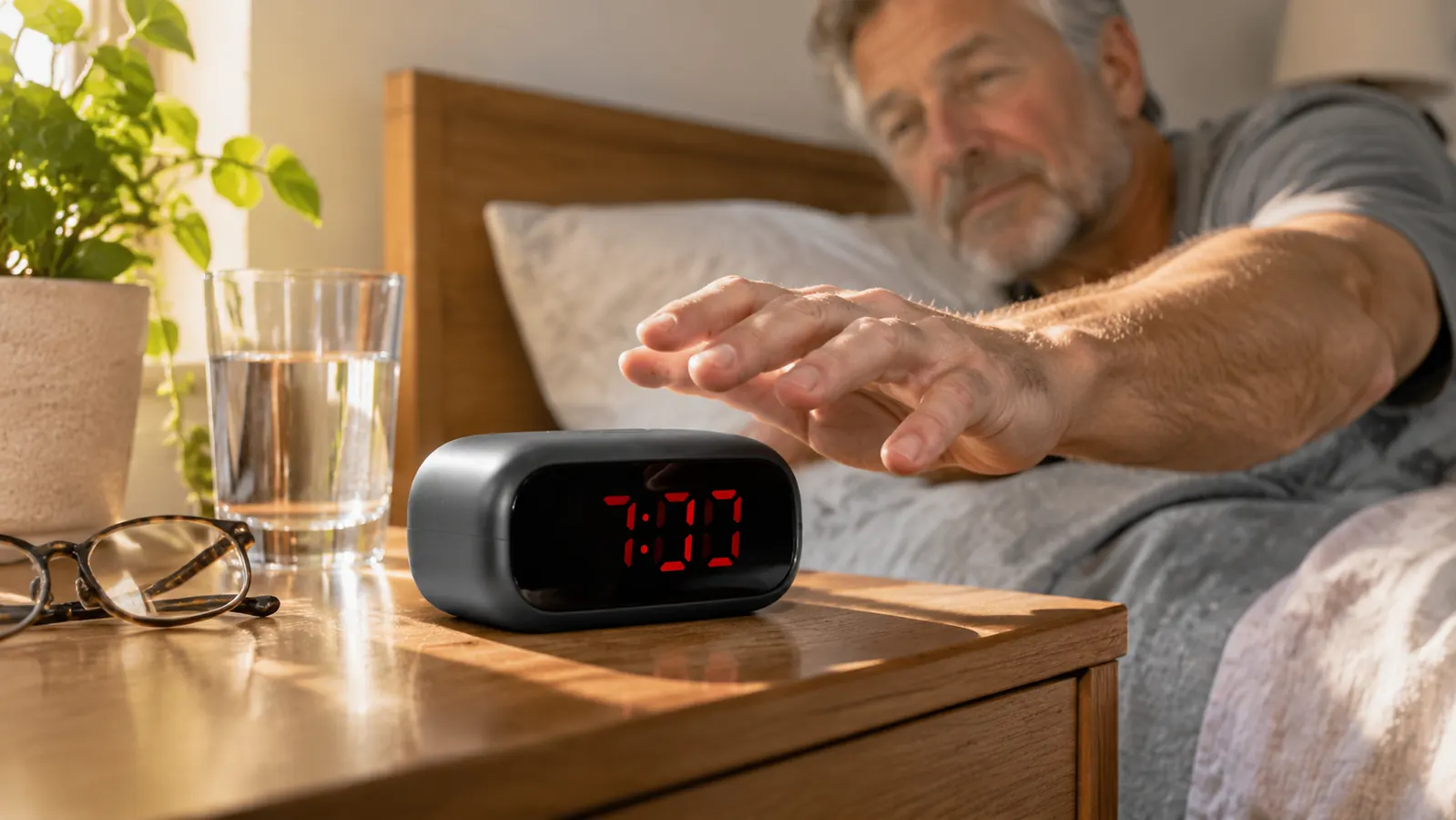
The first thing I noticed, and the reason I kept it, is that the light comes up before any noise. I set my wake time for 6:20. Somewhere ahead of that, the screen begins to glow and builds from dark toward full, quietly, in a way that does not startle. By the time the tone arrives I am already half awake and turning toward it instead of away from it. Compare that to a phone alarm, which is a bolt out of nothing. Six months in, I have not once had the jolt where my heart is going before my eyes are open.
The snooze is short and you pick how short
My old habit was four or five phone snoozes at nine minutes each, which adds up to a second and worse round of sleep. The JALL lets me set the snooze anywhere from 5 to 20 minutes. Mine is set to 10. There is something about choosing the number myself that makes one snooze feel like a decision and two feel like a mistake. I take one most mornings and I am up. This is not discipline I found somewhere. The clock just makes the reasonable option the easy one.
Two alarms, set differently for weekdays and weekends
Paul is retired too, but he still gets up early on Saturdays for the farmers market and I do not. The dual alarm setup lets me run a weekday routine and a weekend routine separately, with everyday, weekday, or weekend options. I do not have to rebuild the whole thing on Friday night, which was the step that killed every other alarm clock I have owned. Small feature. It is the difference between a clock I use and a clock I ignore.
Seventeen light modes make it the lamp I reach for at 3 a.m.
I did not expect to use it as anything but an alarm. It carries 17 light modes, and the one I settled on is soft enough that when I wake around 3 and need to cross the room, I am not flooding the bedroom and waking Paul. The overhead light at that hour is a mistake. This is not. The small lamp on my side of the bed barely gets switched on anymore, which also cleared a little space on the nightstand.
Twenty-five sounds cover two very different noises
I keep a separate white noise machine on the nightstand and it does the heavy lifting at home, covering Paul's light snoring and the neighbor's early truck. The JALL carries 25 nature sounds and white noises of its own, which is what I actually pack when I fly to see my kids. On those trips the clock does the masking and the waking, and I leave the machine at home. Having the options in one place means I stop guessing at 11 p.m. about what will work.

The sleep timer runs long enough to outlast a bad night
Sound timers on most devices cut off in 30 or 60 minutes, which is fine until you are having one of those nights. The JALL sleep timer runs from 10 to 480 minutes. I use 90. On a rough night I use 240. It means the sound is still there while I am lying awake at 1:30 counting backward from 100, and it is off by morning without me touching anything. I do not have to get up and restart a device at the exact moment I am closest to sleeping.
FM radio for the mornings I want a human voice
This is the feature I assumed was filler. It is not. Some mornings I want the local station, a traffic report, and a voice that is not mine. The FM radio pulls in the Tampa stations fine from the nightstand. I use it maybe twice a week. The rest of the time it is the wake light and a gentle tone. But having it in the same unit means I did not buy a second radio, and it means the clock earns the square of nightstand it takes up.
It sits still, which a phone does not
The listing puts it at 1.2 pounds and 7.2 inches wide, and it is made to sit flat on a tabletop. That sounds like nothing. It matters because I have knocked a phone off the nightstand at 4 a.m. more than once, and because this one is powered by a USB cord, so it stays where I put it. It fits between my water glass and the sound machine without a fight, and I never have to hunt for it.
My phone stays in the kitchen now
This is the reason I would buy it again. Before the JALL, my phone was my alarm, which meant my phone was within arm's reach at 10 p.m., at 3 a.m., and at 5:40. Now it charges on the kitchen counter. I am not going to pretend that made me sleep perfectly. I will say that I stopped checking the time on a screen that also has email on it, and the 3 a.m. waking got shorter and a lot less interesting. That alone was worth the shelf space.
It got me back on the 6:30 walk
The point was never the clock. The point was three miles before the heat. I have walked most mornings since about a month after I set it up, and the mornings I miss are the ones where I stayed up too late, not the ones where I slept through the light. For a 54-year-old with a knee that complains and a husband who snores, that is the whole return on the exercise. Everything else is just equipment.
What I'd Skip
Two things I would tell you before you buy. First, the sunrise does not treat insomnia. It does not put you to sleep and it does not keep you asleep. It wakes you more gently than a phone does, which is a smaller claim than it sounds, and I would rather say that plainly than have you buy it expecting a cure. Second, if your bedroom is already bright at 6 a.m., this does nothing you cannot get by leaving the curtains open. I bought it because my blackout curtains work too well. That is a specific problem with a specific answer. One more note: the sound is gentle, so if you are a very heavy sleeper you may want both alarms set rather than trusting the tone alone to move you.
Six months in, I have not once had the jolt where my heart is going before my eyes are open.
The clock was the easy part. The walk was the point.
If you have made your bedroom too dark to wake up in, the JALL sunrise alarm clock is the cheapest way back I found. Light builds first, the sound comes after, and the phone stays in the kitchen.
Amazon Check Today's Price on Amazon →