
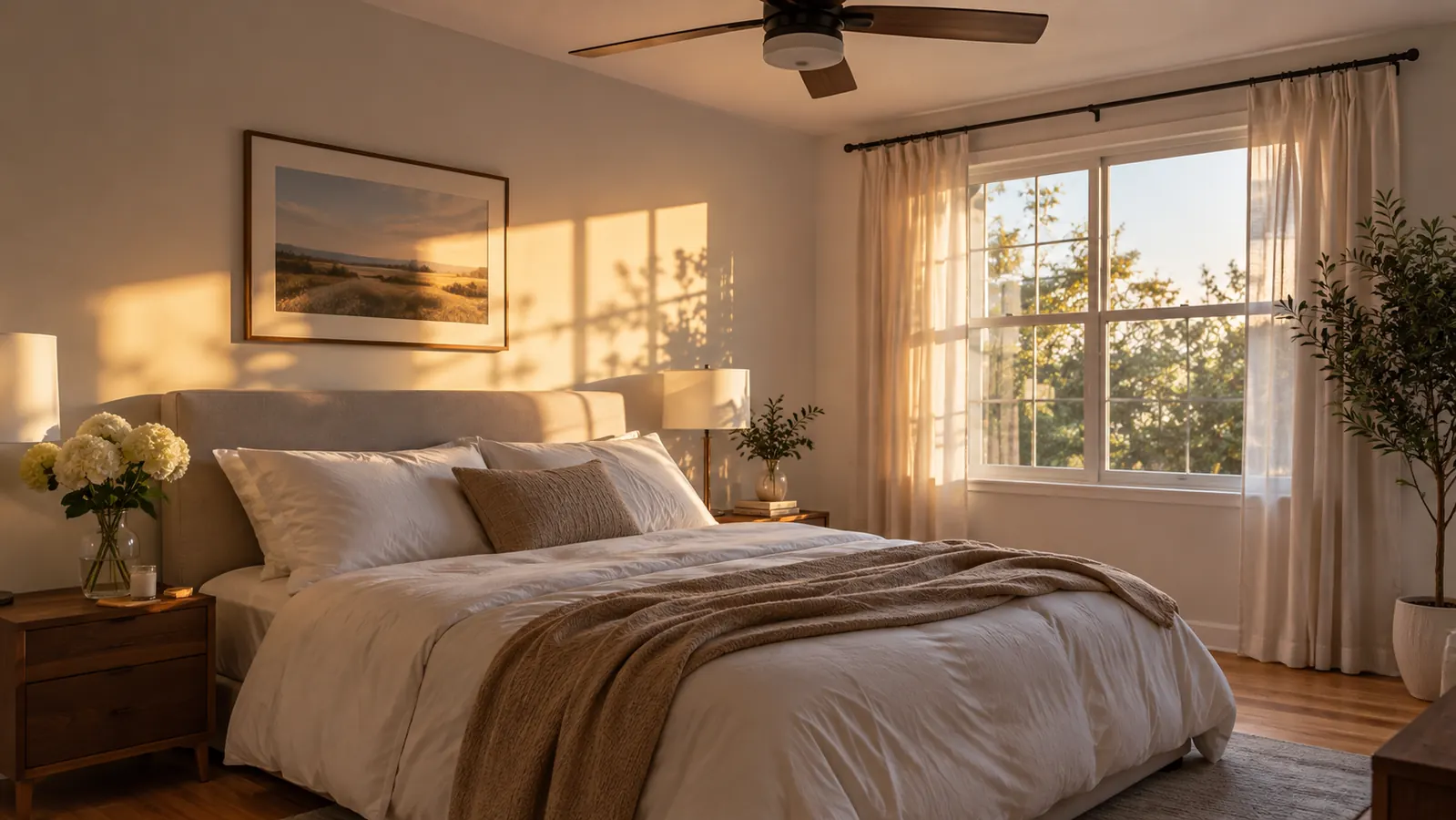
At 6:45 every morning the sun clears the fence behind my neighbor's yard and lands flat on my side of the bed. Not a soft glow. A hard, warm square of light that finds my face no matter how I have rearranged the pillow. I timed it twice with the kitchen clock, once in late June and once in the middle of August, and got 6:44 and 6:51. For two years I told myself this was simply what sleep looked like at 54, that a retired school nurse who already wakes around 3 a.m. should not expect much past dawn, that the light was a small thing I could live with. That was a story, and a convenient one. The morning it finally occurred to me that I had a window problem and not a sleep problem, everything got simpler.
Two things changed it. The first was a sleep mask, which I will come back to. The second, about two months later, was a pair of NICETOWN blackout curtains, two panels of 42 inches wide by 63 inches long, hung on a plain rod over that one east-facing window. Paul and I put the rod up about a year ago on a Saturday afternoon, him on the step stool and me holding the level and offering opinions. It took about an hour, most of which was finding the studs. The room went dark enough that I checked the clock twice. I want to be straight with you about what those panels do and do not do, because the talk around blackout fabric tends to oversell the result, and then people blame themselves when a stripe of light still shows at the top of the rod.
The panels that got the sun off my face
Two panels, 42 by 63 inches, grommet top, hung in an afternoon. Current sizes and today's price are on the listing.
Amazon Check Today's Price on Amazon →Step 1: Measure the Window, Then Buy Wider Than the Window
Most people measure the glass and buy a curtain that covers the glass. That is the first mistake, and it explains a good number of the one-star reviews on every blackout panel I have looked at. Light does not stop politely at the edge of a pane. It spills around the frame, over the top of the rod, and through the seam where two panels meet in the middle.
The glass on my window is 34 inches wide and 58 inches tall inside the frame. Measure that, then measure the wall you actually have on either side of it, because the second number is the one you need. My panels are 42 inches wide each. Hanging two of those on a rod that runs a few inches past the frame in both directions means each panel covers past the edge of the window instead of stopping at it. The extra fabric is doing real work. It is not decoration, and it is the reason a slightly generous size beats a precise one.
Length matters for the same reason. Measure your drop from the rod, not from the top of the frame, and be honest about where you want the hem to land. The 63 inch panels on my window come down past the sill, which keeps the sun from creeping in underneath. A panel that stops at the sill leaves a bright strip along the bottom that you will notice at 6:45 a.m. far more than you would guess from looking at it in the store.
Step 2: Hang the Rod High and Wide, Not Tight to the Frame
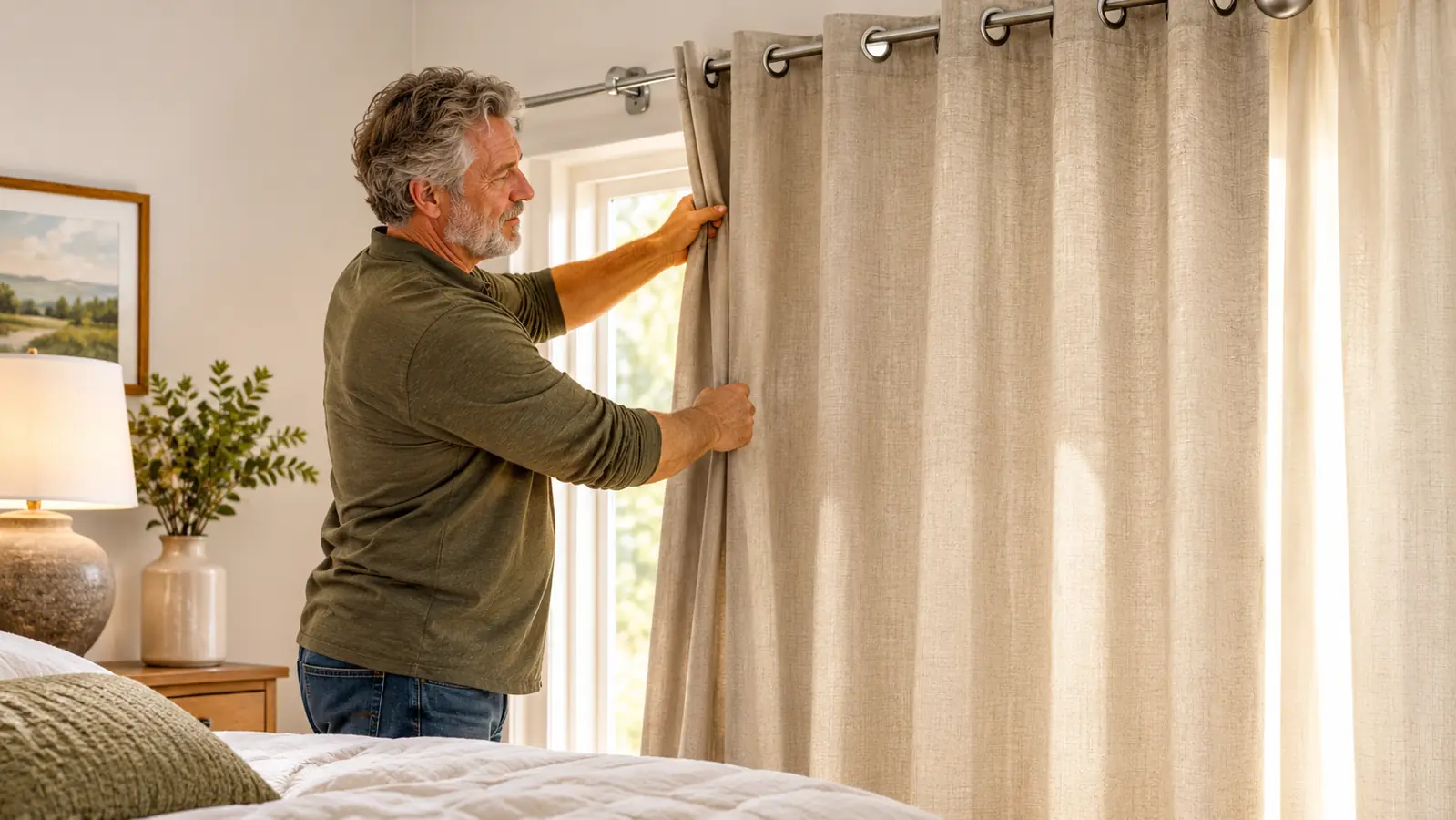
The biggest single improvement in my bedroom came from where we put the rod, not from the fabric. Hang the rod high, either close to the ceiling or at least several inches above the window frame, and run it wide. Light travels in a straight line. A rod mounted tight to the frame gives the morning sun a direct path over the top of the panel and straight onto your pillow.
We got this wrong once. The first brackets went in two inches above the frame, because that is where the old rod had been and I did not want to patch holes, and the panels hung there for a week before I gave up and moved them. The second set of holes went seven inches above the frame, with the rod running a few inches past the window on each side. That is the version that worked, and it worked better than any change of fabric would have. Two extra holes in the drywall was a cheap price.
These are NICETOWN panels, grommet top, six grommets across the top of each one, with a ring opening of 1.6 inches inside diameter. That fits an ordinary curtain rod without any hardware beyond the rod and its brackets. You slide the panels on before you mount the rod, which I did not do the first time and had to undo. Paul found that funnier than I did.
A grommet panel also slides easily, which matters more than it sounds. Every night I pull mine closed with one hand from the side of the bed. A curtain that sticks or drags is a curtain that stays half open, and half open is the same as no curtain on the mornings when you are already too tired to fix it.
Step 3: Close the Gaps the Fabric Does Not Cover
Once the panels are up, you will find where light gets through. In my room it is two places: a bright line down the center where the panels meet, and a thin glow along the top of the rod. Neither one is a defect in the curtain. It is geometry, and it has an answer.
Fix the center by overlapping. Buy a rod wide enough that the two panels can cross each other by several inches in the middle rather than meeting edge to edge. Mine cross by about four inches, and that four inches is the difference between a bright seam running down the middle of the bed and nothing at all. If you have the wall for it, a wrap-around rod or a return bracket pulls the panel back toward the wall at each end and cuts the side leak. For the top, some people add a short valance or a strip of fabric across the rod. I did not bother, because the glow at the top of my rod does not reach my face.
What I will say plainly is that these curtains alone do not give you a cave. The listing puts the fabric at 85 to 99 percent light and UV blocked, higher with darker colors, and that matches what I see from the bed. There is still a faint outline of the window when the sun is full on it. The first night I lay in a genuinely dark room and listened to the ceiling fan and took longer than usual to fall asleep, which I had not expected. If you need total darkness, you need a mounting setup that seals the edges, or a sleep mask, or both. That is the honest version, and it is still a large improvement over a bare window.
The room went from bright enough to read the clock without my glasses to dark enough that I checked the time twice, sure the power had gone out.
Step 4: Treat the Window as a Heat Problem Too
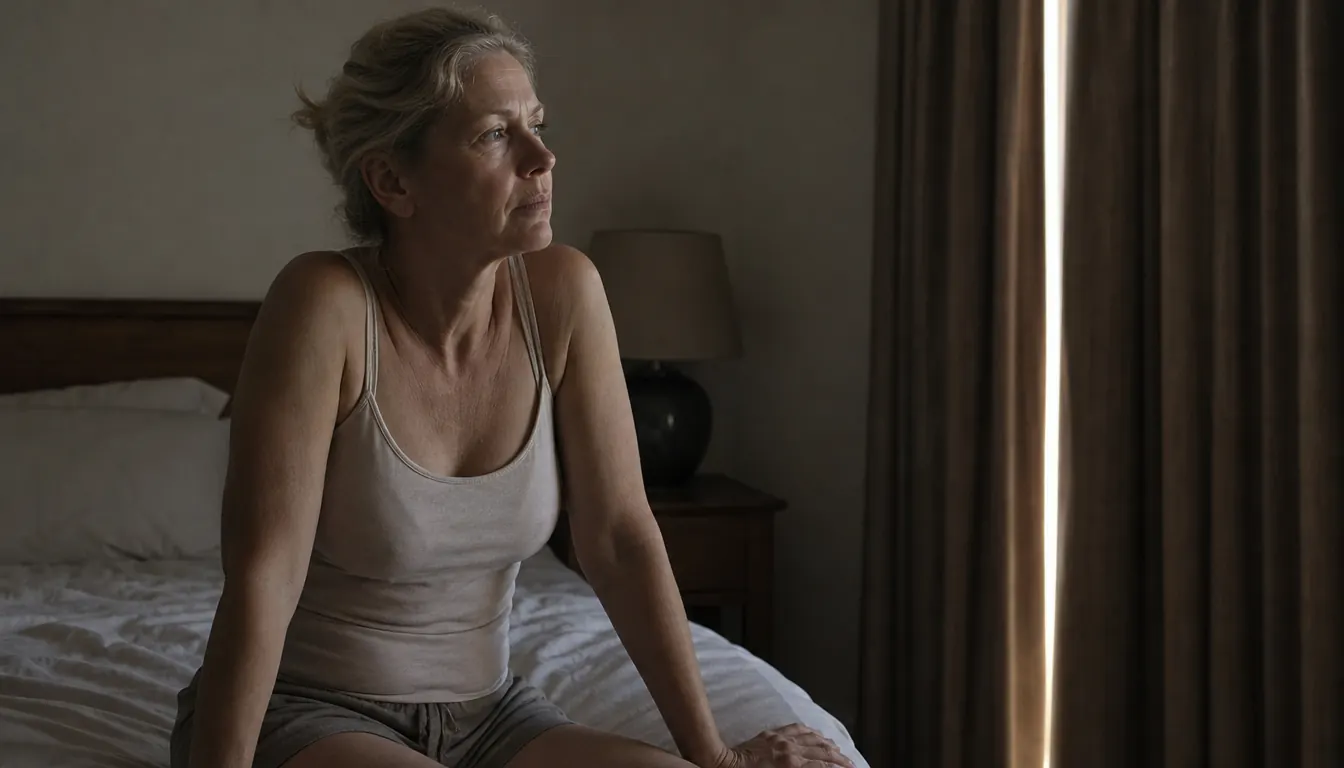
An east window is two problems wearing one coat. The first is light. The second is heat, and in Tampa the heat is the one that lingers. The sun leaves that side of the house by mid-morning, but the glass has spent two hours pouring warmth into the room, and the room holds it.
The NICETOWN fabric is a triple weave polyester, unlined, about 0.2 inches thick, with the pair listed at roughly 2.1 pounds. That is heavier than a sheet curtain and lighter than a lined hotel drape. It sits against the window doing the job of a barrier. The listing describes it as balancing room temperature by insulating against summer heat and winter chill. In plain terms, the window stops acting like a radiator for part of the day.
I put a small thermometer on the sill that first August, mostly out of curiosity. By 8 a.m. the glass behind the panels was hot to the back of my hand and the room was running a few degrees warmer than the hallway by bedtime. The following summer, with the panels up from the first hot week, that gap mostly closed. I will not tell you it replaced the air conditioning. It did not. On the worst nights Paul still runs hot and the ceiling fan still earns its place. What changed is that the room does not gain heat through that window all morning, so the AC is not fighting the sun from 7 a.m. onward. Small thing. It shows up in how the room feels at bedtime, and it is the reason I stopped dreading the walk from the kitchen to the bedroom in July.
Step 5: Take Back Your Morning With Light You Control
Here is the part nobody warns you about. When you finally get a bedroom dark, you will oversleep. I did, for about six weeks. My 6:30 walk slid to 7:15, then to skipping it, and I could not work out why I felt worse in a darker room than I had in a bright one.
The answer was obvious once I said it out loud. I had spent two years fighting the sunrise, and then I had removed my only reliable alarm. Florida light is a blunt instrument, but it is dependable. A bedroom that is genuinely dark will let you sleep straight through a morning you meant to use.
So I added a sunrise alarm on my nightstand, set to start brightening at 6:00 with a gentle sound at 6:20. It sits next to the white noise machine. Paul is not woken by it most mornings, which was the condition for keeping it in the room. Dark at night, light where I choose it in the morning. That is the whole system, and the curtains are the first half of it.
What Else Helps
Nothing else in my bedroom does the curtain's job, and I try to keep it that way. Each thing I added solves one problem, and I add one at a time so I can actually tell what worked. Five changes in one month and you learn nothing except that something helped.
The sleep mask came first, about 14 months ago, before the curtains. I still wear it, mostly because Paul reads in bed with a small lamp on his side for about 20 minutes after I turn in. Curtains do nothing about a lamp inside the room. That is a separate problem with a separate answer, and mine travels with me when I visit my kids out of state.
The white noise machine on my nightstand covers Paul's light snoring and the neighbor's truck that starts before dawn. It masks sound. It does not stop anyone from snoring, and I would not pretend otherwise to anyone who asked me. Noise and light are two different leaks in the same boat.
The cooling sheets are for Paul running hot through a humid summer, and they help him more than me. On the hottest nights the fan and the AC still do most of the work there. The NICETOWN panels are the only thing in that room addressing the window itself, and that is exactly the job I bought them for. They have been machine washed once, cold, and came out of the dryer without a crease worth mentioning. If you want the longer account of how they held up over a year of nightly use, I wrote that separately.
One window, one afternoon, a different 6:45
Two panels at 42 by 63 inches, grommet top, on a rod a few inches above the frame. That was the entire change. Current sizes and today's price are on the Amazon listing.
Amazon See Current Price and Sizes on Amazon →