
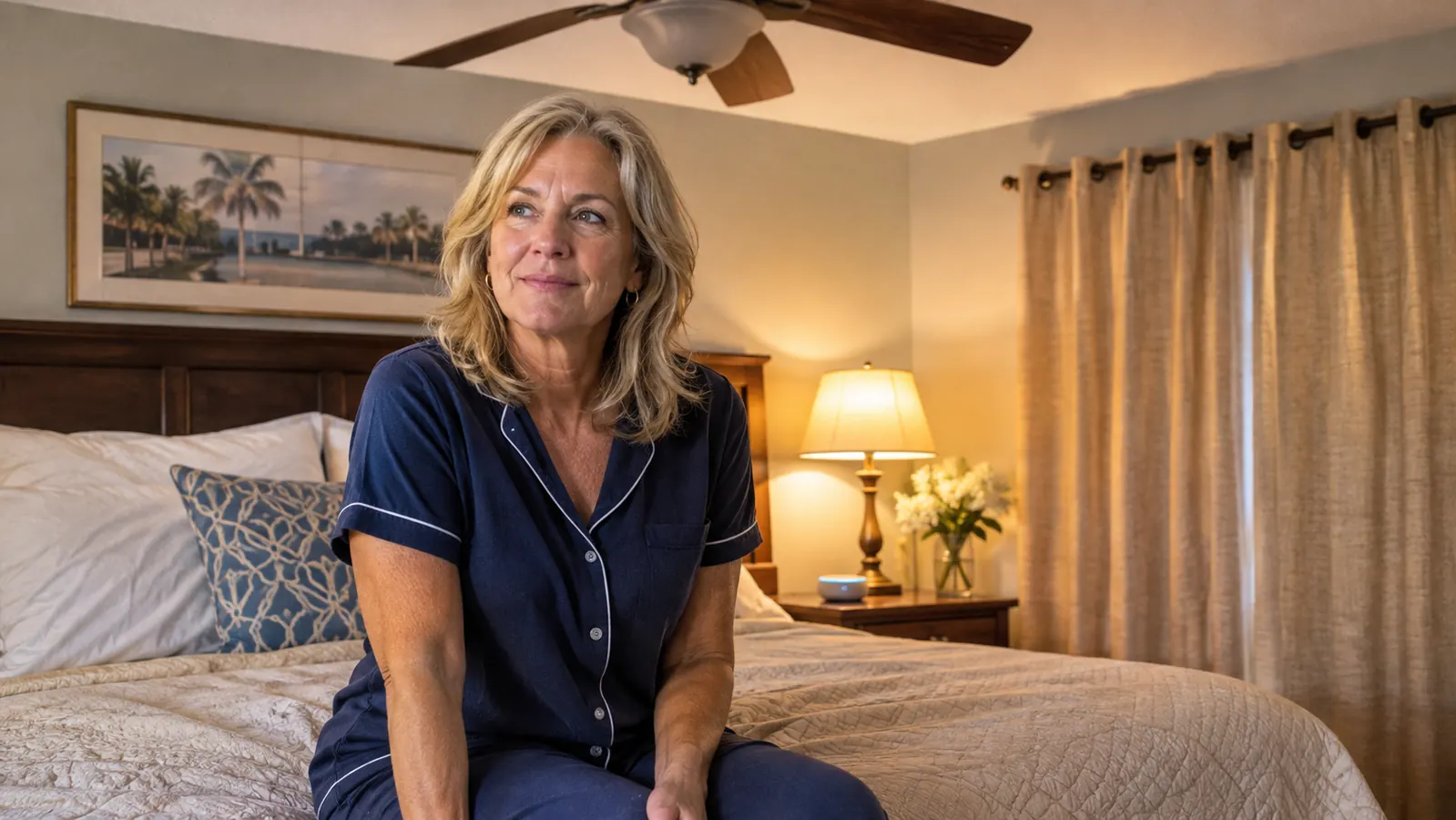
Paul snores. Not the kind that wakes the neighbors, just the steady, uneven kind that starts about twenty minutes after he falls asleep and saws along at a volume that makes my brain sit up. For a long time I did what tired people do: I lay there and listened to it. I tried going to bed earlier. I tried a fan. I tried telling myself I would get used to it. I did not. What finally helped was not a cure and not a gadget that promised to stop him. It was a small sound machine on my nightstand, the Homedics SoundSleep, doing one job well: giving my ears something steady to rest on.
I am not a sleep specialist. I am a retired school nurse in Tampa, fifty-four years old, and I have spent most of my adult life around practical fixes: wash your hands, drink water, go to bed at the same time. Since I retired my own sleep has gotten lighter, and Paul's snoring and the early Florida sun and the summer heat all land on the same few hours. I test one change at a time. This one was worth keeping.
Give your ears one steady sound instead of one uneven one
The Homedics SoundSleep has six built-in sounds, volume controls, and an auto-off timer, and it runs on the included AC adapter or four AA batteries. It does not stop snoring. It makes the snoring easier to sleep through.
Amazon Check Today's Price on Amazon →What the Machine Can and Cannot Do
A sound machine works by giving your brain a constant, predictable sound to attend to. Snoring is the opposite of predictable. It rises, pauses, catches, and starts again, and those changes are what pull you out of sleep. A steady sound does not erase the snore. It lowers the contrast between the snore and the room, so the snore has less edge. That is the whole trick, and it is enough for a light snorer like Paul.
Think of it as a contrast problem. On a quiet night Paul's snore is the loudest thing in the room, so it wins. Add a steady sound at a level just under the snore and the snore has less room to jump out. It is the same reason a ticking clock disappears once the refrigerator is running. Your ear stops tracking the change because there are fewer changes to track. I learned this the slow way, with a box fan that cycled on and off and woke me each time it did. The machine does the same job without the cycling.
What the Homedics SoundSleep cannot do is open Paul's airway, change his sleep position, or treat a breathing problem. If snoring is loud enough to hear through a closed door, if there are gasps or long pauses, or if Paul wakes unrefreshed, that is a doctor conversation, not a sound machine conversation. I say that plainly because I spent years watching people try to solve medical problems with drugstore purchases.
The Five Steps
Step 1: Put the machine between you and the snore, not on top of your ear.
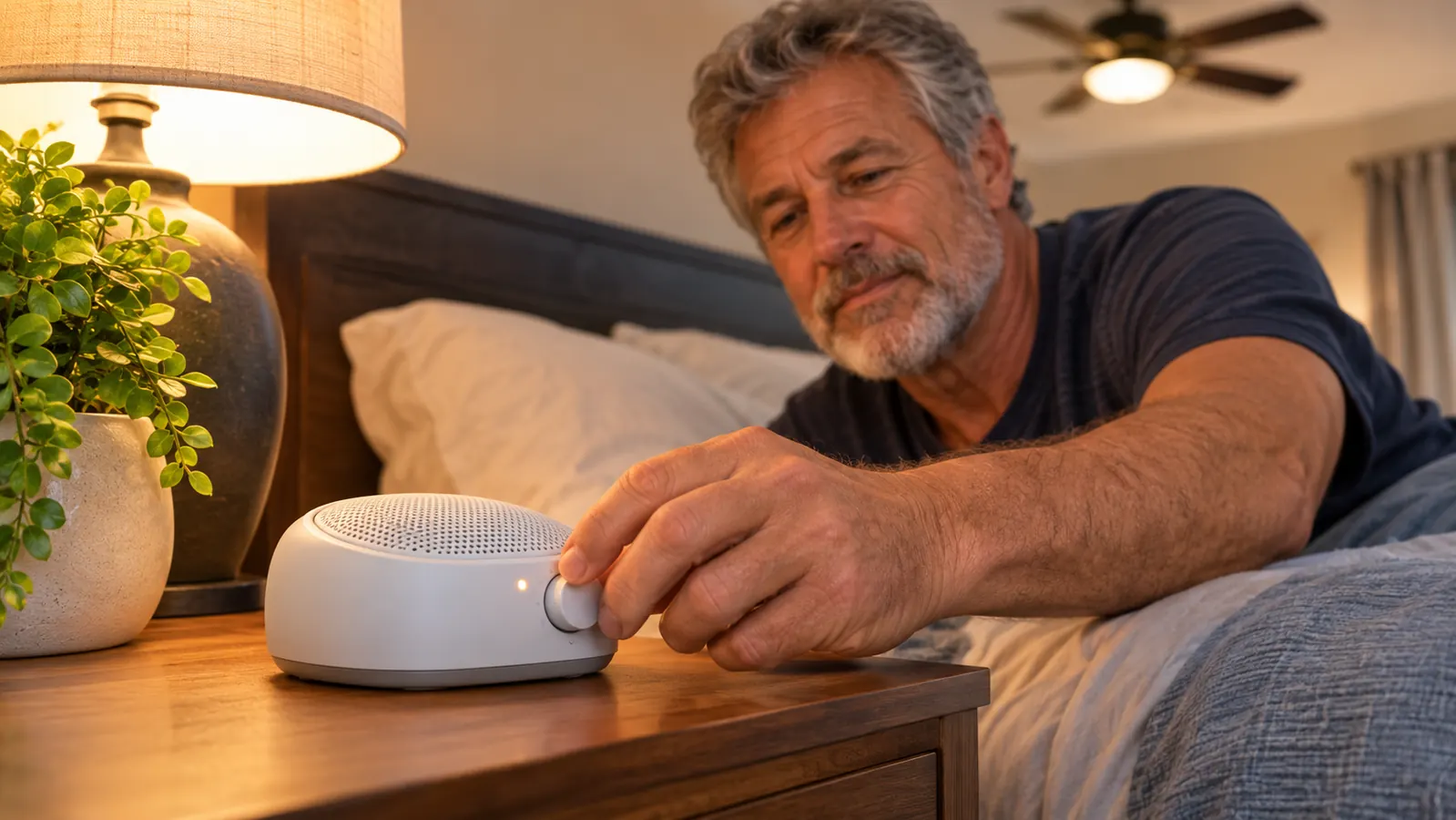
Place the machine on the nightstand on your side of the bed, or on a table between the two of you if you have one. The goal is for the sound to reach your ear at a steady, low level while the snore has to travel past it. In our room the machine sits on my nightstand, about an arm's length from my pillow, and Paul is on the far side of the king bed. That distance matters. A machine right beside your head can be too sharp, and a machine across the room can be too soft to do anything.
The first week I had it, I moved it three times. On the headboard it was too close and too sharp in my ear. On Paul's nightstand it was too far, and he knocked it sideways reaching for his water glass. On my nightstand, at the corner near the lamp, it was right. That corner is about thirty inches from my pillow and about four feet from Paul's. I did not measure any of it until later. I found the spot by lying down and listening, which is the only measurement that counts.
Keep it out of the bed. Not on the pillow, not under the covers, not balanced on the headboard. The Homedics SoundSleep is small, 6.5 by 6 by 2 inches and 8 ounces, so it fits on a nightstand without crowding a lamp and a glass of water. I set mine on a dry cloth coaster because the nightstand is wood and I do not like rings. That is not a product requirement. It is just what happens when a nurse has owned furniture for thirty years.
Step 2: Choose the steadiest sound, not the most interesting one.
The machine has six built-in sounds. I use the white noise setting most nights. White noise is the least interesting sound on the machine, and that is the point. You do not want a sound that makes your brain follow along. You want a sound that disappears. If white noise feels too harsh, one of the other five may suit you better, but give each one a full night before you decide. Switching sounds every twenty minutes is just another way to stay awake.
I also use the ocean setting on the bad nights, the ones where Paul is congested and the snore has a wet, rattling edge. Ocean has more movement in it than white noise, which usually works against you, but on those nights the extra movement gives my brain more to follow and I fall asleep faster. I do not use it every night. It is a tool for specific nights, the way a heavier blanket is a tool for a cold snap. And I still give every sound a full night before I decide anything about it.
Start with the volume low. Low enough that you can still hear Paul's snore if you listen for it, but not so low that the snore cuts through. Then leave it alone. I made the mistake of turning the volume up every time Paul shifted. By the third night the machine sounded like a shower running and I was sleeping worse than before. The right volume is the one you stop noticing. On the Homedics, the volume control is on the unit, so I set it before I get into bed and then keep my hands off it.
Step 3: Put the machine on a hard, stable surface and aim it toward the room.
Sound bounces. A machine on a soft surface, like a towel or a stack of books, gets muffled and uneven. A machine on a hard nightstand sends a steadier sound into the room. I have mine on the nightstand with nothing leaning against it. I also keep it a few inches back from the wall so the sound does not come back at me off the corner. Small placement changes are easy to test. Move it six inches and listen. If the sound gets sharper or thinner, move it back.
Do not point it directly at your ear from six inches away. Point it across the nightstand, toward the middle of the room, or slightly toward the ceiling. The sound should fill the gap between you and Paul, not drill into your head. This is also why I do not put it on Paul's side. He runs hot and rolls around, and a machine on his nightstand would get bumped, covered, or unplugged. On my side it stays where I put it.
Step 4: Decide whether you need it all night or just to fall asleep.
The Homedics SoundSleep has an auto-off timer and can also play continuously. For light snoring that starts when Paul falls asleep and settles later, a timer may be enough. Set it for thirty or sixty minutes, let it cover the transition into sleep, and let it go quiet. For snoring that runs all night, use it continuously. I use mine continuously, plugged in with the AC adapter and no timer. Paul's snore does not clock out at midnight, so the machine does not either.
Battery power is useful if you want to move the machine around or if you travel. It takes four AA batteries. I keep it plugged in at home because I do not want to think about batteries at ten at night. The one time I used batteries was during a power blink, and it kept running without me having to reset anything. That is not a reason to buy it. It is just one less thing to worry about.
Step 5: Make the rest of the room boring, then give the routine two weeks.
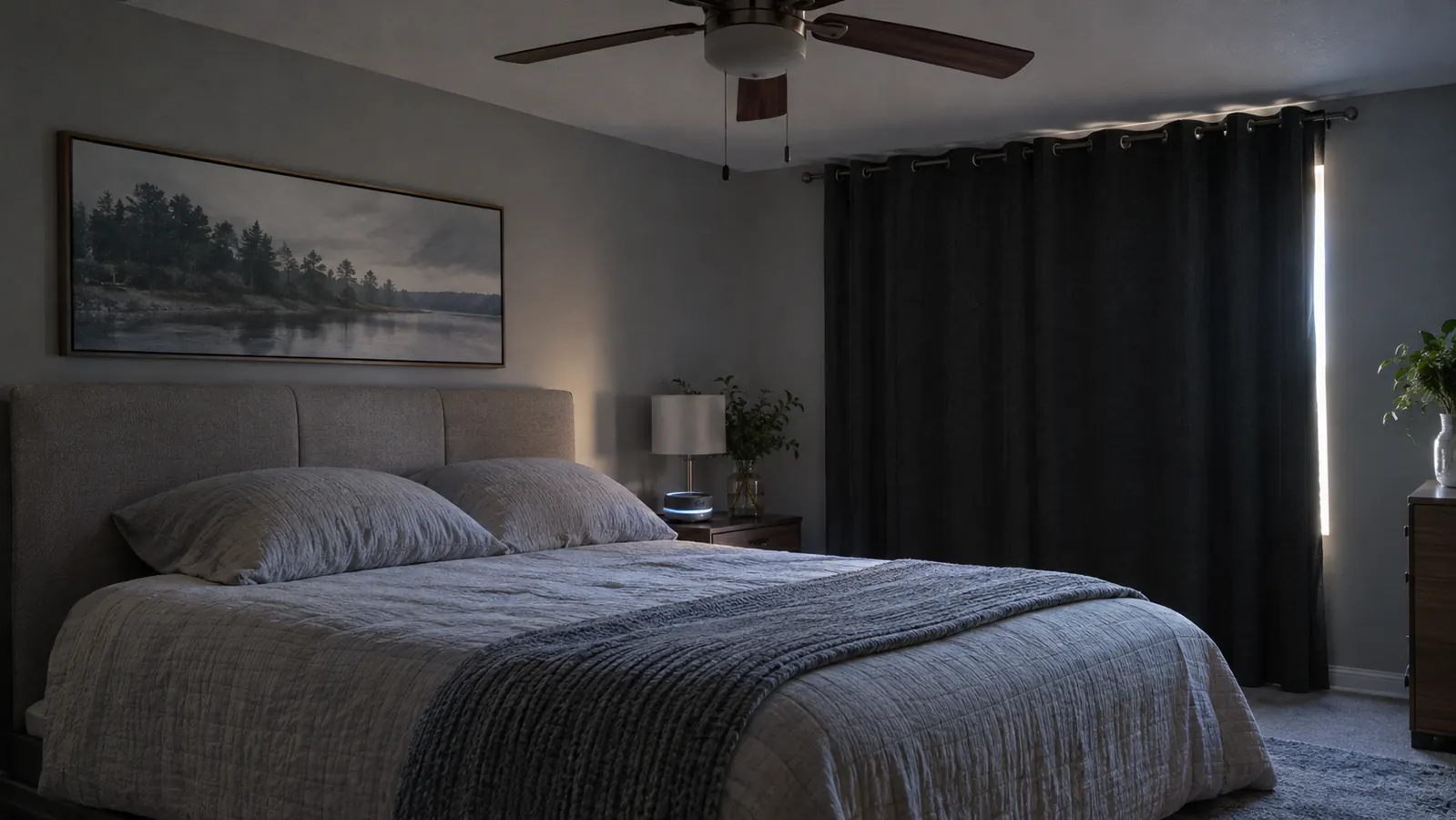
A sound machine is not a substitute for a dark, cool room. Ours is a single-story house with one east-facing window that gets direct sun from about 6:45 in the morning. We put up blackout curtains about a year ago, and they do more for the early light than any sound could. The ceiling fan and central air set to 72 do more for Paul's heat than any sheet. The sound machine handles the noise. It does not handle the light or the temperature, and I do not ask it to.
The rest of the routine is dull, which is why it works. Caffeine stops at noon. I walk three miles most mornings around 6:30, and I do light strength work twice a week, mostly because my knees asked for it. Paul reads in bed with a small lamp on his side for about twenty minutes after I turn in, and that lamp is why a sleep mask lives in my nightstand drawer. None of that is the sound machine. All of it decides whether the sound machine has a chance.
Give the setup two weeks before you judge it. The first night I used the Homedics I was listening to the machine instead of the snore, which is not the same as sleeping. By the fourth night I stopped hearing both. That is the test. If after two weeks you are still lying awake doing math about decibels, change the sound, change the volume, or move the machine. If you are still awake after that, the problem may be bigger than noise.
The machine does not stop Paul's snoring. It gives my brain a steady thing to listen to instead of an uneven thing, and some nights that is the whole difference.
What Else Helps
Paul sleeping on his side helps more than anything I can put on a nightstand. He is not perfect about it. He starts on his side and ends up on his back by two in the morning, which is when the snore changes. A pillow against his back is a low-tech fix that works about half the time. If he has had a drink or is stuffed up, the snore is worse, and no sound setting covers it completely. Those are the nights I use earplugs as a backup and let the machine do what it can.
It also helps to keep the room's other noises from stacking up. The neighbor's truck starts around 5:30 some mornings. The ceiling fan clicks on low. The AC cycles. Each one is small on its own, but together they make a jagged background that the snore cuts through. The Homedics smooths that background. That is why I notice it most on windy nights and least on quiet ones. It is not doing anything dramatic. It is filling in the gaps.
If you are the one who snores, get checked if the snore is loud, if you wake with a dry mouth or a headache, or if you feel sleepy during the day. I say that as a nurse, not as a sleep expert. A white noise machine is a masking tool. It is not a diagnosis and it is not a treatment. The same goes for earplugs, nasal strips, and every other thing sold in the sleep aisle.
One job, done quietly, night after night
If the problem is a light, steady snore and a brain that will not stop listening for it, the Homedics SoundSleep is a reasonable place to start. Six sounds, volume control, auto-off timer, AC adapter or four AA batteries. It will not fix the snore. It will give you something steadier to sleep on.
Amazon Check Today's Price on Amazon →